


Blog · FP&A Insights
The 30-minute board prep: a CFO's Monday drive with Seizmic
Thirty minutes in the car, a board meeting on Wednesday at 12:00, and a conversation with the AI engine in Seizmic FP&A. Here is what board prep looks like when finance can talk to its own numbers.
By Hardus Odendaal, Subject Matter Expert, Seizmic · 8 November 2026
Most CFOs I know start their week the same way. Monday at 07:00 they open the laptop, open twelve tabs, and spend the morning working out what happened last week before they can decide what to do about it.
With the board meeting on Wednesday at 12:00, that morning usually turns into two days.
I think that's about to change. Not because of a better dashboard, but because finance will be able to have a conversation with its own numbers. To show you what I mean, here's a Monday morning drive, told from the CFO's seat.
06:55. Leaving the house
Thirty minutes to the office. Coffee in the cup holder, phone on the dash, Seizmic on hands-free.
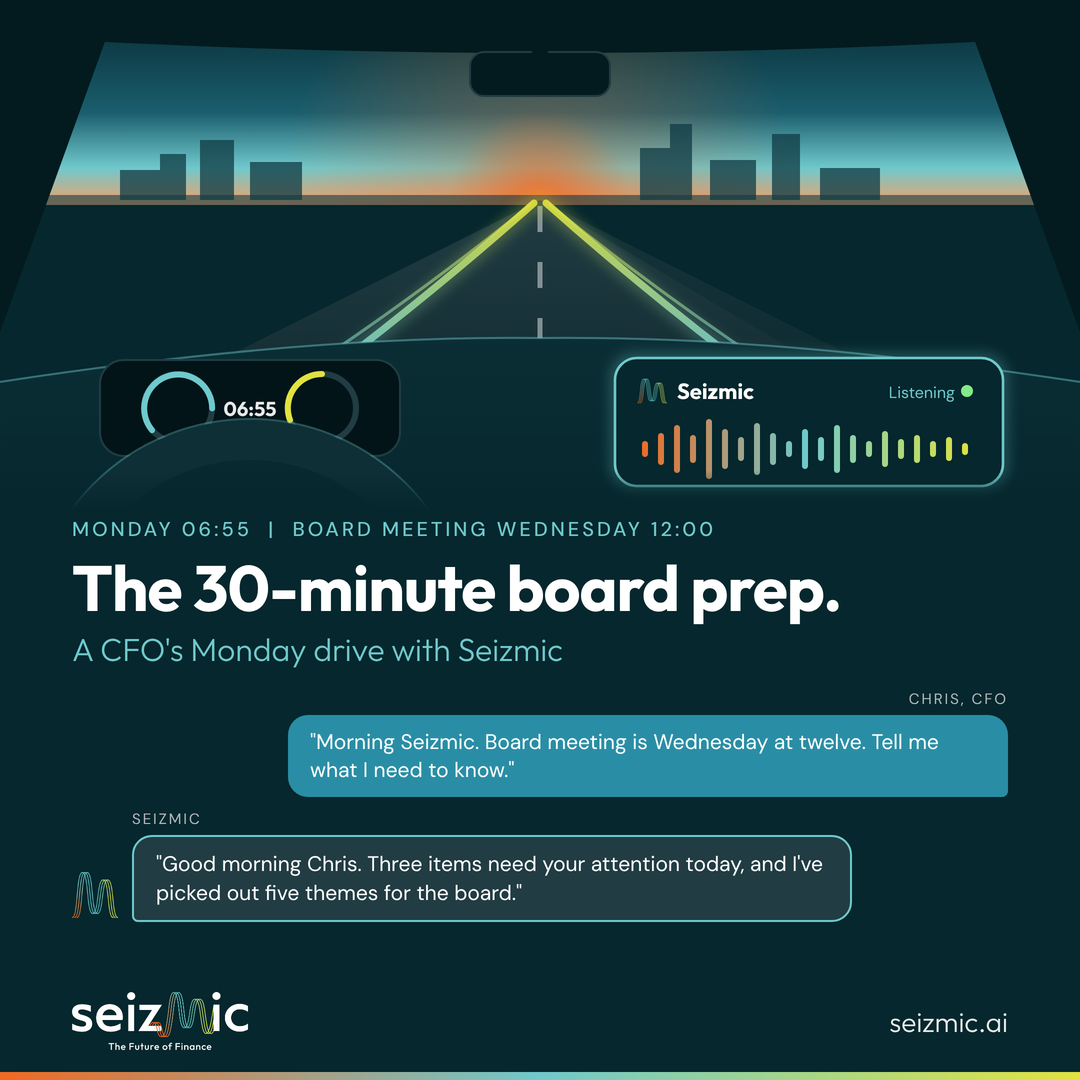
"Morning Seizmic. Board meeting is Wednesday at twelve. Tell me what I need to know."
"Good morning Chris. October actuals closed on Friday. Group revenue is 3.1% behind budget and 1.4% behind the latest forecast. Gross margin is 1.8 points below budget. Three items need your attention today, and I've picked out five themes for the board. Do you want the urgent items first?"
"Yes. Burning platforms first."
07:00. The burning platforms
"Three items:
1. One of our top three customers is now 47 days past terms with 6.8 million outstanding. Including that balance, cash headroom against the bank covenant drops to 11% at month end.
2. Scrap at Plant 2 jumped from 2.4% to 5.9% last week. If it continues, November material cost goes 1.2 million over plan.
3. Four cost centers are more than 10% off budget and have not submitted commentary. The board pack locks tomorrow at 17:00."
"Who owns the four cost centers?"
"Assembly, Maintenance, Logistics and IT. Assembly is the biggest gap: overtime is 18% over budget."
"Send all four owners a reminder. Commentary by 12:00 today, and copy their GMs."
"Done."
07:06. Actual, budget and forecast, with the business's own explanation
This is the part that used to take a day. Every cost center owner in our business has to add commentary when they're above or below budget or forecast. Usually that commentary sits in a spreadsheet nobody reads. Now it's part of the model.
"Why is gross margin down 1.8 points? Use the cost center commentary."
"Three drivers. Material price accounts for 0.9 points: the steel price increase in September wasn't in the budget, and Procurement's commentary confirms the supplier contract reprices again in January. Mix accounts for 0.6 points: we sold more of the lower-margin product range to our second customer. Plant 2 scrap accounts for 0.3 points. The Plant 2 manager's commentary says a die change caused the spike and it was fixed on Thursday."
"Is the fix showing in the numbers?"
"Partly. Friday's scrap was 3.1%, still above the 2.4% plan. One day isn't enough to confirm the trend."
"And the volume shortfall?"
"Our top customer cut its build schedule by 9% for the quarter. Sales commentary says the schedule recovers in February. That isn't in the 9+3 forecast yet."
"So the forecast is too optimistic for Q4?"
"Yes. If the 9% cut holds through December, the year-end EBITDA landing drops from 2.3% below budget to 4.1% below."
07:12. A quick what-if
"Run it with the steel increase in January and the volume back in February. What does next year's first quarter look like?"
"Revenue recovers to budget by March. Margin stays 0.7 points below plan unless pricing moves. A 2% price increase on the affected product range closes most of the gap."
"Keep that scenario. I'll need it on Wednesday."
07:15. The five things for the board
"Give me the five things I need to focus on before Wednesday."
"Based on materiality and what the board asked about in September:
1. Year-end landing: EBITDA now forecast 4.1% below budget if the volume cut holds.
2. Material cost: the steel price exposure and the January repricing.
3. Cash and working capital: the overdue customer and covenant headroom.
4. Labor efficiency: Assembly overtime and what's driving it.
5. Pricing: the case for a 2% increase on the affected range, with the scenario you just saved."
07:18. Building the outputs
"Create a one-page variance report on Plant 2 and Assembly, with the commentary, and send it to the COO and both plant managers."
"Drafted. Do you want to review it before I send it?"
"Send it to my inbox. I'll release it when I'm at my desk."
"Now build a new CFO's View board report. Five themes as sections, a revenue bridge from budget to the latest forecast, the cash headroom chart, and the Q1 scenario."
"Created and saved in the board folder. It's built on the same model as the pack, so the numbers reconcile."
07:21. My commentary in the board pack
"Open the CFO commentary section of the board pack. Add this: October revenue was 3.1% behind budget, driven by a 9% schedule cut from our largest customer, which we expect to recover from February. Margin pressure is mainly material price, and we will bring a pricing recommendation to this meeting. Tighten the wording, but keep my points."
"Updated. I've marked the paragraph as draft so the Financial Controller can review it."
"Last thing. Book 30 minutes with the Assembly manager this afternoon, and 15 minutes with the credit controller before ten."
"Booked, Chris. 09:30 with credit, 14:00 with Assembly."
07:25. Parking
I get to the office with a plan for the week, the board story roughed out, two meetings booked and a report waiting for my sign-off. I haven't opened a spreadsheet yet.
Why this matters
None of this is science fiction. The hard part was never the voice interface. The hard part is having actuals, budgets, every forecast version, volumes and cost center commentary in one governed model, so the answer you get on the highway is the same number that appears in the board pack.
Three things make this work:
1. One trusted data foundation. If the AI can't see budget, forecast and actuals in one place, it can't explain the gap between them.
2. Commentary as data. When cost center owners have to explain their variances, and that explanation is stored next to the numbers, the AI answers with the business's reasoning, not its own guess.
3. The CFO stays in charge. Seizmic drafts, calculates and chases. The CFO decides what goes to the board, what gets sent, and what the story is.
Board prep has always been half analysis and half assembly. AI takes the assembly away. What's left is the part only the CFO can do: judgment.
So what would you ask your numbers on the drive in tomorrow?
For more information, or to see Seizmic FP&A on your own numbers, contact us at seizmic.ai/contact.
See Seizmic FP&A on your own numbers
Talk to us about how Seizmic FP&A brings actuals, budgets, forecasts and commentary into one model your AI can answer from.
About the author
Hardus Odendaal is Group CEO of TrueNorth Group, the Data and AI consultancy behind Seizmic, and has worked in data and analytics for finance teams for over 25 years. He works with CFOs and finance leaders in South Africa and the United States on the Microsoft Data & AI Platform and AI-driven FP&A.