


Blog · FP&A Insights
Decide while it matters: how AI moves the CFO's decision point earlier
Most finance teams deliver insight after the moment it could have changed anything. Here is why that happens, why it hurts manufacturers most, and how AI brings the decision forward to where it counts.
By Hardus Odendaal, Subject Matter Expert, Seizmic · 25 October 2026
The decision that arrives after the fact
Every CFO knows the feeling. The month-end pack lands on your desk, the variances are clear, and the explanation is sound. The problem is that the month it describes is already over. The overtime has been paid, the material has been bought at last quarter's price, and the customer who quietly shifted their order mix has done so for six weeks running.
The pack is accurate. It just arrives too late to change anything.
This is the central tension in most finance functions today. FP&A exists to improve decisions, yet the way most teams work means the insight shows up after the moment when a decision could have made a difference. The analysis is good. The timing is wrong.
In this article I want to look at why that happens, why it matters most in manufacturing, and how AI is moving the point at which a finance-backed decision can be made from the end of the cycle to the start of it. I'll also show, with practical examples, how we approach this at Seizmic.
The month-end trap
Ask a finance team where their time goes in a typical month and the answer is remarkably consistent. Most of it is spent getting the numbers ready, not using them.
A typical cycle looks like this:
1. Collect. Extract the trial balance from the ERP, pull volumes from operations, chase cost centre owners for accruals and commentary.
2. Reconcile. Match the GL to the subledgers, align entities to a common chart of accounts, fix mapping breaks, rebuild the spreadsheet links that broke since last month.
3. Format. Build the income statement, the cost centre reports and the customer views, then paste charts into the board pack.
4. Explain. Write the commentary, often in the last day or two before the deadline, under pressure and with little time to dig.
Only at step four does finance start to add value the business can act on. By then the window for action has usually closed.
The result is a function that is busy, competent and largely reactive. It reports what happened with great precision, but it rarely shapes what happens next. Senior finance people spend their best hours on mechanical work, and the business makes its real operational decisions on instinct in the gap between one pack and the next.
This is not a people problem. It is a structural one. When data lives in several systems, every month starts from scratch. When the chart of accounts is mapped differently across entities, every consolidation needs manual correction. When budget and forecast versions live in separate spreadsheets, every comparison needs to be rebuilt. The effort goes into the plumbing, and the insight comes last.
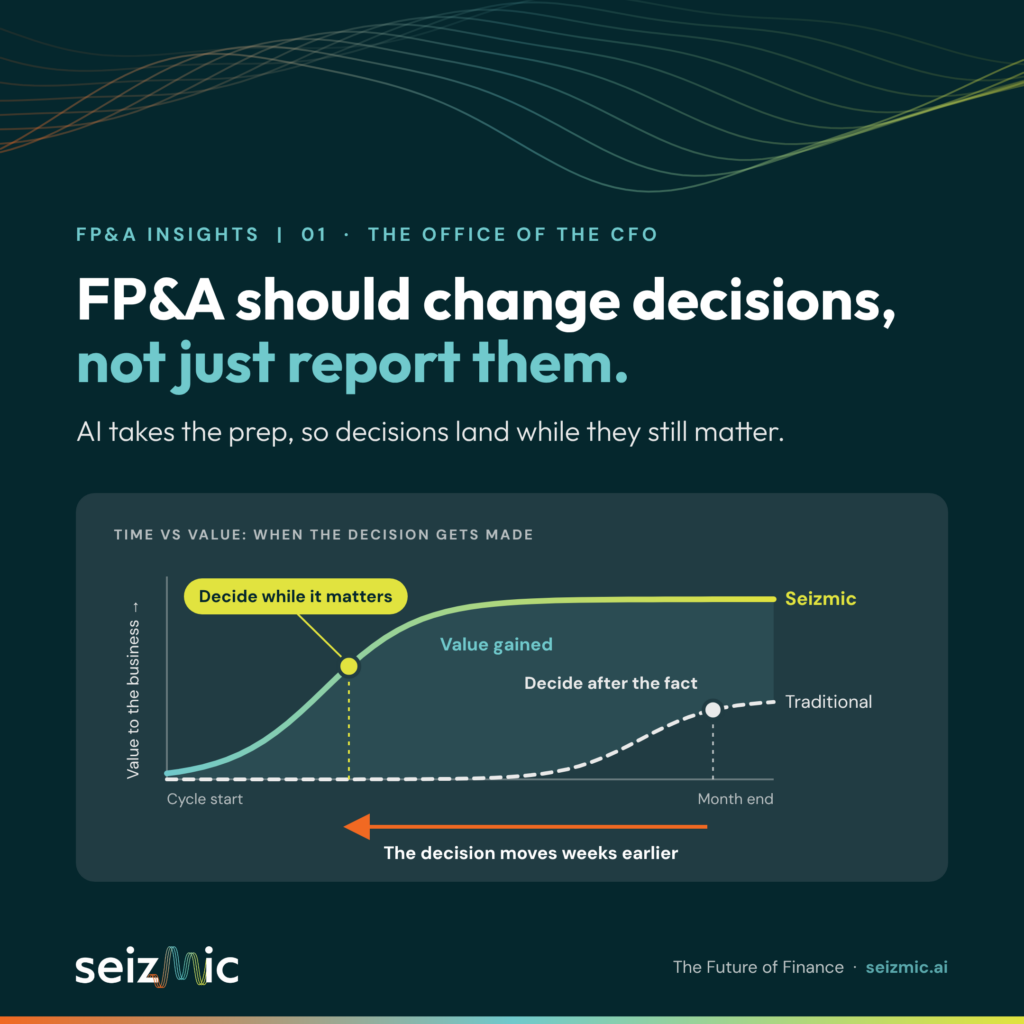
If you plot the value finance delivers against time in the cycle, the traditional curve stays flat for weeks and only rises near month end. The decision it supports arrives after the fact.
Why manufacturing feels it most: material and labour
In manufacturing, the cost of a late decision is easy to see, because two cost drivers dominate the income statement: material and labour. Between them they usually make up the bulk of the cost of sales, and both move faster than a monthly reporting cycle.
Material is exposed to supplier price changes, exchange rates, freight, scrap and the product mix your customers actually order. A few things regularly catch finance teams out:
A supplier increase that lands mid-month but is only visible once the purchase price variance is calculated at month end.
Items in the sales plan that have no standard cost loaded, so the budgeted margin on those lines is overstated from day one.
A shift in customer mix towards lower-margin assemblies that leaves revenue on target while material cost per unit climbs.
Labour is exposed to overtime, shift patterns, absenteeism, temporary staff and volume swings. Here the traps are just as common:
Overtime that creeps up in a busy month and looks justified against higher volume, until you flex the budget and find the efficiency has dropped.
Cost centres that are under budget only because a vacancy hasn't been filled, which hides a run-rate problem for next quarter.
Labour planned against last year's volumes rather than the current forecast, so the plan and the shop floor drift apart.
In each of these cases, the information to make a better decision exists inside the business. It is sitting in the ERP, the payroll system and the production schedule. What's missing is the ability to bring it together and act on it while there is still time to renegotiate the price, adjust the shift roster or reprice the customer.
That is the gap AI is now able to close.
What AI changes in the Office of the CFO
Much of the conversation about AI in finance focuses on automation: fewer hours, smaller teams, lower cost. That misses the bigger shift. The real change is in timing.
The tasks that consume most of the cycle (collecting, reconciling, formatting and drafting) are exactly the tasks AI now handles well. When those steps take minutes rather than weeks, the value curve changes shape. Insight is available early in the cycle, while there is still room to act on it. The decision point moves from month end to the moment it matters.
Three changes stand out for the Office of the CFO.
From scheduled reporting to continuous insight. Instead of waiting for the pack, finance can see how material, labour and margin are tracking against plan as the data lands. The monthly pack becomes a confirmation of decisions already taken, rather than the first sight of a problem.
From building reports to asking questions. A CFO or financial controller can ask "why is margin down for this customer?" or "which cost centres are running above budget on overtime?" in plain language and get an answer drawn from governed data. The question no longer has to wait for an analyst to build a new view.
From writing commentary to reviewing it. AI drafts the first version of the variance commentary in business language. The analyst's job becomes checking it, adding context only a person close to the business would know, and turning it into a recommendation.
There is an important condition attached to all of this. AI is only as good as the data it can see. An AI agent working from inconsistent account mappings, unstructured budget versions and disconnected spreadsheets will produce answers that sound confident and are wrong. In finance, that is worse than no answer at all. Moving the decision point earlier requires a trusted data foundation first, and AI second.
How Seizmic moves the decision point earlier
We built Seizmic around that order: foundation first, then intelligence. Seizmic runs on the Microsoft Data & AI Platform. It brings the GL, budget, forecast, volume and customer data into one governed model with a consistent chart of accounts, and puts AI on top of that model. Every answer the AI gives traces back to the same numbers that appear in the board pack.
Here is what that looks like in practice, using the issues raised above.
Example 1: Material cost that has moved since the plan was set
A supplier price increase lands in the second week of the month. In a traditional cycle, finance sees it as a purchase price variance after month end, by which point several weeks of orders have been quoted and shipped at the old margin.
In Seizmic, the AI compares live material cost per stock code with the cost assumed in the plan. It highlights the items where cost has moved most, shows which customers and products those items feed into, and estimates the margin impact on the rest of the year. Finance can raise it with procurement and sales while there is still time to renegotiate or reprice.
Example 2: Sales plan lines with no cost behind them
During budgeting, new part numbers often enter the sales plan before a standard cost has been loaded. Those lines show full revenue and no material cost, which overstates the budgeted margin.
Seizmic flags every item in the sales plan that has no cost attached, and shows the revenue and customers at risk. Instead of discovering the gap when actuals come in below plan, finance closes it before the budget is signed off.
Example 3: Labour that looks fine until you flex it
Overtime is up 18% on budget in a month when volumes were also higher. On the face of it, that looks reasonable.
Seizmic analyses labour by cost centre and GL against budget and forecast, and puts it next to the volume actually produced. The AI can show whether labour cost per unit has held or slipped, which cost centres drove the change, and how the trend compares with prior months. The production manager gets that view mid-month, while the roster can still be adjusted.
Example 4: A forecast that has drifted without anyone noticing
Most manufacturers re-forecast several times a year, but versions often live in separate spreadsheets, which makes comparison slow.
In Seizmic, the budget and every forecast version (for example the 6+6 and the 7+5) are stored as structured data in the same model. A CFO can ask "what changed between the 6+6 and the 7+5, and which cost centres drove it?" and get an answer straight away, along with the volume, price and mix effects behind it.
Example 5: Budget commentary that doesn't explain the number
Cost centre owners submit their budgets with commentary, but finance rarely has time to read all of it before review meetings.
Seizmic reads the contributor comments against the numbers they support and rates each one for quality, flagging comments that are missing, vague or inconsistent with the figure. Finance goes into budget reviews knowing exactly which lines need a conversation.
Example 6: Month-end packs and commentary in minutes
Once the data is governed, the pack itself is no longer the bottleneck. Seizmic produces the Income Statement, the Manufacturing Cost Statement, the Administrative Cost Statement and customer-level management statements directly from the model, with a first draft of the variance commentary broken down into volume, price and mix. Analysts spend their time reviewing and sharpening, not building.
At a glance
The issue
What happens today
How Seizmic addresses it
Material price movement
Seen as a variance after month end
Live cost per stock code compared with plan, with customer and margin impact
Uncosted items in the sales plan
Margin overstated until actuals arrive
Flagged during budgeting, before sign-off
Labour and overtime
Judged on the total, not per unit
Analysed by cost centre and GL against budget, next to volume
Forecast drift
Versions compared by hand in spreadsheets
Every version in one model, compared on request
Weak budget commentary
Found in the review meeting
Rated for quality before the meeting
Month-end pack
Days of building and drafting
Generated from the model, commentary drafted by AI
What changes for the finance team
The natural worry with any conversation about AI in finance is headcount. In our experience, that's the wrong lens. The finance team doesn't get smaller. It moves up the value chain.
When the mechanical work is handled, three things happen.
The team's time shifts to judgement. Analysts spend less time reconciling and more time understanding the business: walking the shop floor, talking to sales about pricing, working with procurement on supplier terms. That is where finance earns its seat at the table.
Finance becomes part of the operating rhythm. Instead of appearing once a month with a pack, finance contributes to weekly production and commercial meetings with current numbers. Decisions about pricing, staffing and purchasing are made with financial insight in the room, not reviewed after the fact.
The CFO's conversations with the board change. When the pack confirms decisions already taken, board discussion moves from "what happened?" to "what are we doing about it, and what does the rest of the year look like?" That is a far more valuable use of the board's time, and of the CFO's.
None of this removes accountability. AI drafts, people decide. Every number still traces back to the ledger, every comment is still reviewed by someone who understands the business, and every decision still belongs to management.
Where to start
Moving the decision point earlier doesn't require a big-bang transformation. For most finance teams, a practical sequence looks like this:
1. Measure where the time goes. Track one month-end cycle honestly: how many hours go into collecting, reconciling and formatting, and how many into analysis and recommendations. The ratio is usually the most persuasive business case you'll find.
2. Pick the decisions that matter most. In manufacturing, start with material and labour. Identify the two or three decisions where earlier insight would have changed the outcome in the past year: a price increase absorbed for too long, overtime that ran unchecked, a customer whose mix shifted.
3. Fix the foundation. Bring the GL, budget, forecast and volume data into one model, with one chart of accounts mapped consistently across entities. Define your key measures once, so gross margin means the same thing in every report.
4. Put AI on governed data, not on spreadsheets. Start with a narrow set of questions on the decisions you picked in step two, and expand as trust builds.
5. Change the rhythm, not just the tools. Bring finance insight into the weekly operating meetings where material and labour decisions are actually made. The technology only pays off if the decision moves too.
The test of success is simple. Six months from now, are the important decisions being made with financial insight before the month closes, or still explained after it?
Decide while it matters
FP&A has always been meant to shape decisions, not just report them. For most of its history, the mechanics of data got in the way, and insight arrived after the moment it could have counted.
AI changes that, provided it sits on a foundation finance can trust. When the preparation takes minutes rather than weeks, the decision point moves from month end to the moment it matters. For manufacturers, that means acting on material and labour while there is still time to change the outcome.
That is the future of finance we are building at Seizmic.
See Seizmic on your own numbers
See how Seizmic helps manufacturing finance teams plan, forecast and analyse in time to act.
About the author
Hardus Odendaal is Group CEO of TrueNorth Group, the Data and AI consultancy behind Seizmic, and has worked in data and analytics for finance teams for over 25 years. He works with CFOs and finance leaders in South Africa and the United States on the Microsoft Data & AI Platform and AI-driven FP&A.