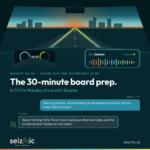
Generative BI is shifting finance from static reporting to live storytelling. Traditional dashboards show performance but fail to explain causality, leaving boards to interpret results themselves. Narrative finance changes that dynamic. By combining trusted data, contextual awareness, and generative AI, CFOs can deliver real-time explanations that clarify why outcomes occurred and what actions matter next. Within 45 days, finance teams can replace retrospective packs with board-ready narratives that surface risk, highlight opportunity, and recommend decisions in the moment. The result is faster conversations, higher confidence, and a finance function positioned as a strategic advisor rather than a reporting engine.

Beyond the Dashboard: Generative BI and the Rise of Narrative Finance

Generative BI is shifting finance from static reporting to live storytelling. Traditional dashboards show performance but fail to explain causality, leaving boards to interpret results themselves. Narrative finance changes that dynamic. By combining trusted data, contextual awareness, and generative AI, CFOs can deliver real-time explanations that clarify why outcomes occurred and what actions matter next. Within 45 days, finance teams can replace retrospective packs with board-ready narratives that surface risk, highlight opportunity, and recommend decisions in the moment. The result is faster conversations, higher confidence, and a finance function positioned as a strategic advisor rather than a reporting engine.

Read More
The Compliance Multiplier: How Continuous Controls Drive Strategic Agility

The Compliance Multiplier: How Continuous Controls Drive Strategic Agility

Compliance is still treated by many organisations as a defensive necessity—something that slows decisions, adds cost, and constrains growth. That view is no longer viable. In a world of tighter regulation, compressed cycles, and constant scrutiny, episodic compliance creates friction and amplifies risk rather than containing it.

The strategic shift is toward continuous compliance: controls that operate in real time, embedded directly into financial workflows. When policies are enforced automatically, anomalies are flagged as they occur, and audit trails are created by design, finance leaders gain confidence to move faster—not slower.

This matters now because decision latency is becoming a competitive liability. Organisations with continuous controls can approve faster, respond to risk earlier, and avoid disruptive compliance fire drills. The result is a stronger risk posture, leaner audits, and materially improved execution speed—often demonstrable within 45 days. Compliance stops being a brake on performance and becomes a multiplier of strategic agility.

Read More
Why modern CFOs must redesign finance as a continuous, AI-enabled control system to guide decisions in real time.

The CFO as Systems Thinker: Orchestrating AI for Continuous Finance Control

Finance leaders are under pressure to guide decisions in real time, yet most finance functions still operate on fragmented systems built for periodic control. The result is a widening gap between how fast the business moves and how quickly finance can respond with confidence.

This matters now because decision latency has become a strategic risk. In volatile markets, delayed insight weakens pricing, capital allocation, and risk management—often before issues appear in formal reports. More data has not solved the problem; disconnected systems have compounded it.

The shift required is structural, not incremental. CFOs must redesign finance as a continuously learning system—one that detects signals as they emerge, recommends actions with context, executes controls automatically, and improves through feedback. By architecting AI-enabled control loops, finance moves from retrospective governance to real-time guidance, turning compliance into decision leverage rather than operational drag.

Read More
  • 1
  • 2